AI Cost ROI

Measure what your AI spend returns to the business
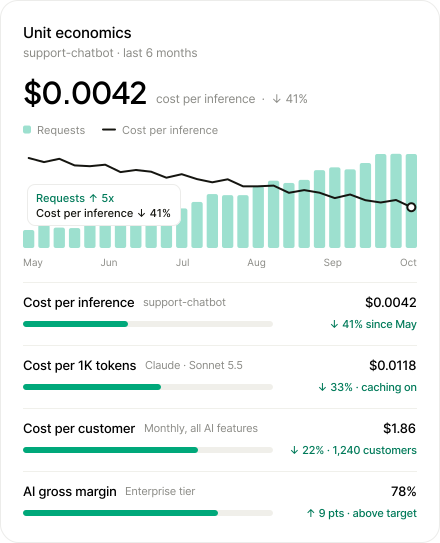
Track AI ROI with cost per inference, per thousand tokens and per customer for each AI feature, and report realized savings apart from savings still in the pipeline.
Schedule a demo
OneLens AI ROI measurement dashboard: support-chatbot cost per inference down 41% to $0.0042 as requests rise 5x

Show how AI gets more efficient as usage grows
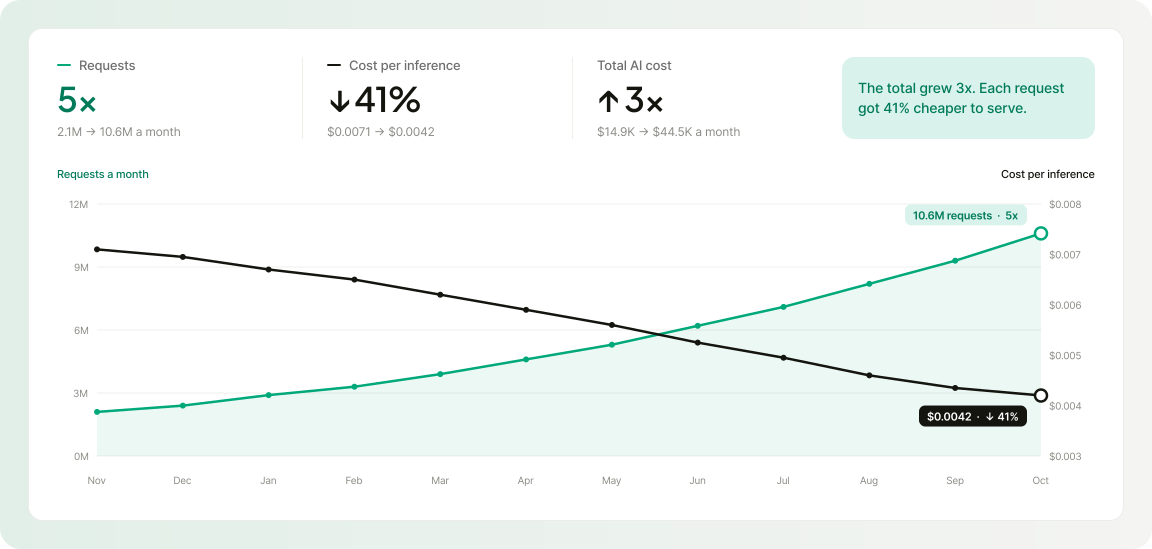
Total AI spend can rise while each request gets cheaper to serve. OneLens shows usage beside unit cost, so leadership sees the AI ROI behind the growth.
AI cost ROI chart: requests grow 5x to 10.6M a month while cost per inference falls 41% to $0.0042

Connect AI cost to the value it produces
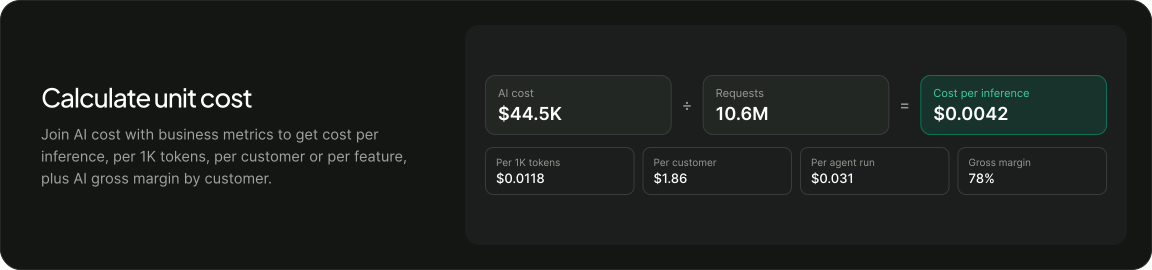
AI unit cost: $44.5K AI cost ÷ 10.6M requests = $0.0042 cost per inference, with 78% AI gross margin
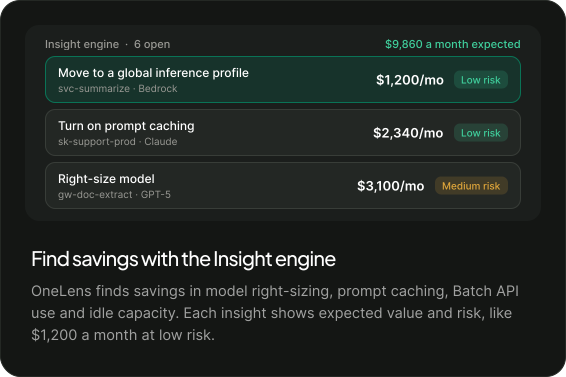
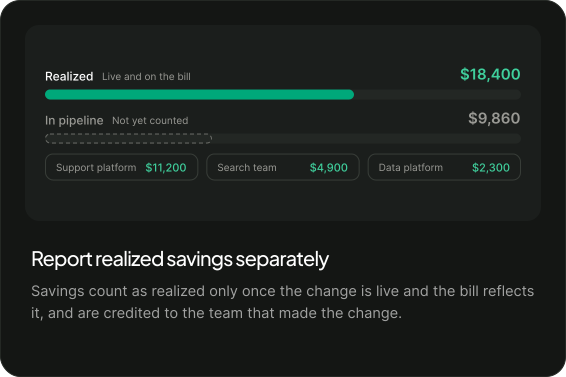
OneLens Insight engine: AI savings from a global inference profile, prompt caching and model right-sizing, each risk-ratedRealized AI savings of $18,400 shown apart from $9,860 in the pipeline, split by support, search and data platform teams
AI ROI roll-up: API keys feed teams and the Customer Experience business unit, at $34.5K AI cost and $16.1K saved

Use unit economics wherever AI has to justify its budget

Report to the board
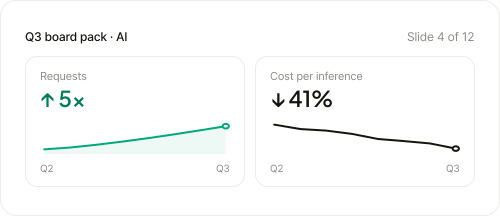
The CFO reports AI ROI to the board with cost per inference falling while usage grows.
Q3 board pack slide on AI ROI for CFOs: requests up 5x while cost per inference falls 41%
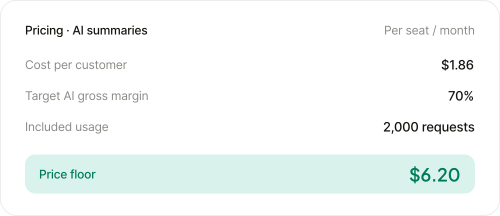
AI feature pricing card: $1.86 cost per customer and a 70% target AI gross margin set a $6.20 price floor per seat

Price an AI feature

Product sets the price or usage limit of an AI feature from its cost per customer and target margin.

Plan next year's budget

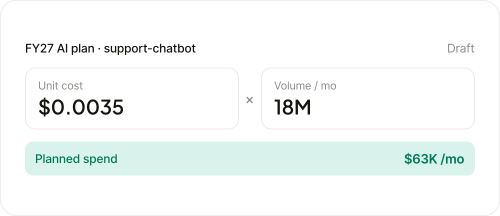
FinOps builds next year's AI business case from unit cost and expected volume, not last year's total.
FY27 AI business case: $0.0035 unit cost × 18M requests a month gives $63K a month in planned AI spend
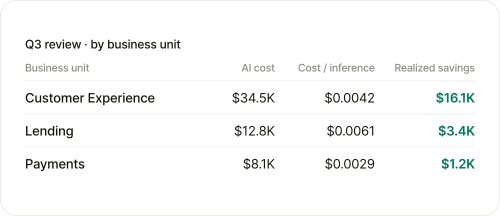
Q3 AI ROI review table: AI cost, cost per inference and realized savings for Customer Experience, Lending and Payments

Run the business unit review

Each business unit sees its own AI cost, unit cost and realized savings in one AI ROI view.

Recap optimization work

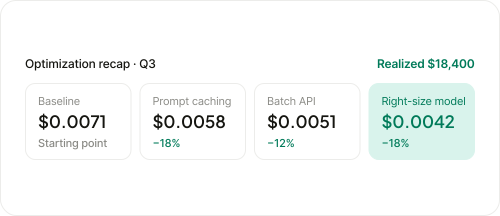
Engineering shows how each change lowered unit cost, with realized savings on the bill to back it.
AI cost optimization recap: prompt caching, Batch API and model right-sizing cut cost per inference from $0.0071 to $0.0042

Measure cost per inference for one of your AI features
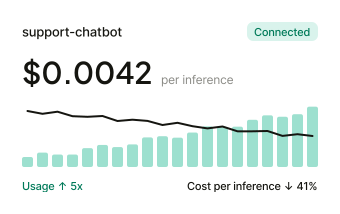
Connect the provider the feature calls and see its cost per inference beside its usage trend.
support-chatbot connected to OneLens: $0.0042 per inference, with usage up 5x and cost per inference down 41%
How do you measure AI ROI?

Join what each AI feature costs with the business metric it serves, then track cost per outcome over time. OneLens does this from provider billing data, so finance sees cost per inference, cost per customer and realized savings for every feature.

What is the formula for AI ROI?

AI ROI = (value delivered − full AI cost) ÷ full AI cost. For unit economics, cost per outcome = cost per token × tokens per task × tasks per outcome. Track both monthly, so a rising total is read against falling unit cost.

What metrics should finance track for AI ROI?

Track cost per inference, cost per thousand tokens, cost per customer, AI gross margin by customer and realized savings. Total AI spend alone can mislead, because usage can grow faster than cost while each request gets cheaper.

How should AI ROI be reported to the board?

Show usage growth beside cost per inference on one chart, then list realized savings by team. Count savings only once the change is live and the bill reflects it, so the board sees verified numbers rather than pipeline estimates.

What software tracks AI spend against the value it delivers?

OneLens by Astuto connects to providers such as OpenAI, Anthropic and AWS Bedrock with read-only billing access. It calculates unit cost per AI feature, finds savings with expected value and risk, and rolls AI ROI up by team and business unit.