

Optimize BigQuery spend without slowing queries
.png)
13%
36 hrs
$70K+
12+
Connect BigQuery without changing how a single query runs
OneLens connects through read-only access to your billing data and BigQuery job, reservation and table metadata, with nothing to deploy and no impact on query performance.
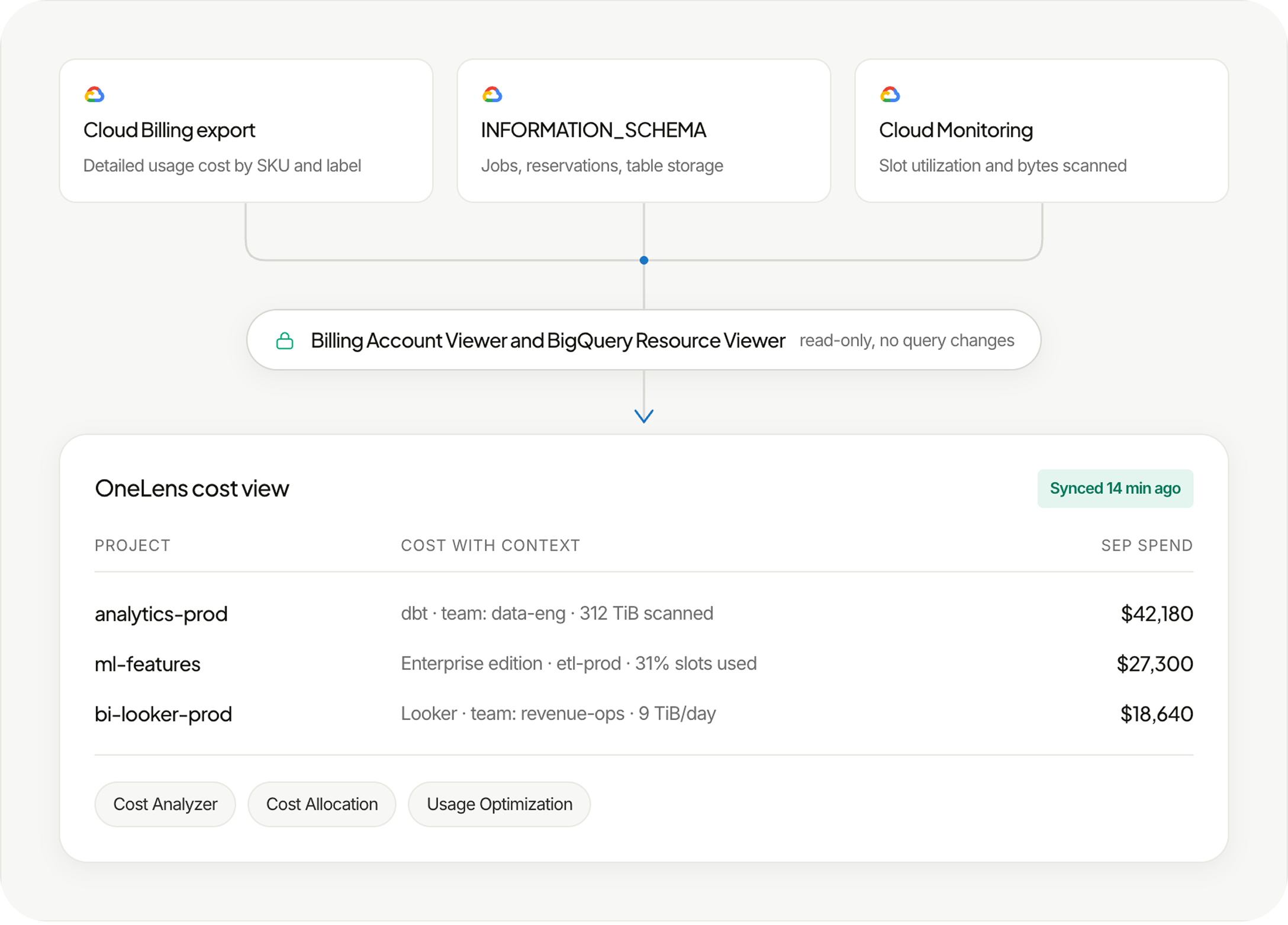
Trace BigQuery cost to the query, table and slot behind it
Tie every BigQuery query and job to the team, pipeline or dashboard behind it
Look past the project total to the service account, dbt model, Looker dashboard and user behind each job. Bring that spend together by team for showback and chargeback, so every owner sees their own share.
.png)
Find the queries scanning terabytes and the fix for each one
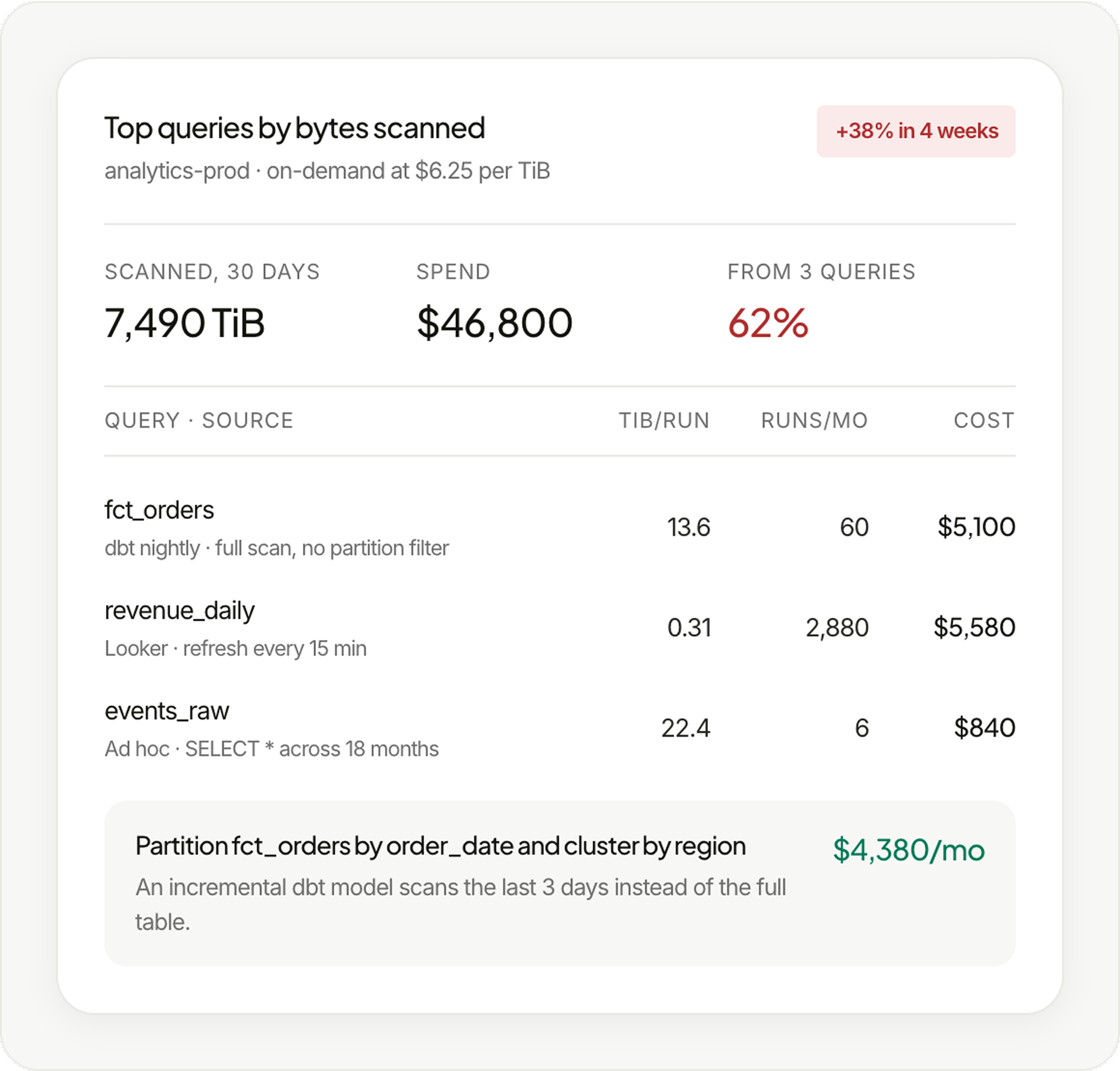
Match each workload to on-demand or Editions and size its slots
.png)
Move the right datasets to physical storage billing
.png)
Find tables nobody has read in months, with owner and last use
.png)
Keep BigQuery savings in place with spend alerts and query byte limits
Catch spend anomalies by project, team or job and route them to Slack or email for the owner. Apply recommended byte limits and quotas so a single runaway query stays inside the budget.
.png)
Connect BigQuery spend to the jobs, usage and teams that create it
.svg)
Give every query an owner
Allocate BigQuery spend across projects, reservations, service accounts, labels and teams, including shared slot capacity that several teams draw from.
.svg)
Decide based on warehouse usage
Combine cost with bytes scanned, slot utilization, query frequency and table access history to judge query fixes, reservation size and storage billing.
.svg)
Know what each data product costs
Track cost per dashboard, pipeline, data product or customer, so data teams can see whether warehouse spend grows in line with the value it delivers.
Turn cost signals into work that gets done
OneLens ranks each fix by dollar impact, assigns an owner, routes the next step and tracks warehouse spend against plan.
.png)
Tickets
Create policy-driven tickets with the affected resource, recommended action and potential savings, so the owner has the context needed to act.
Workflows
Set budgets by team, project or reservation, compare actual and projected month-end spend, and alert owners as BigQuery spend approaches the limit.
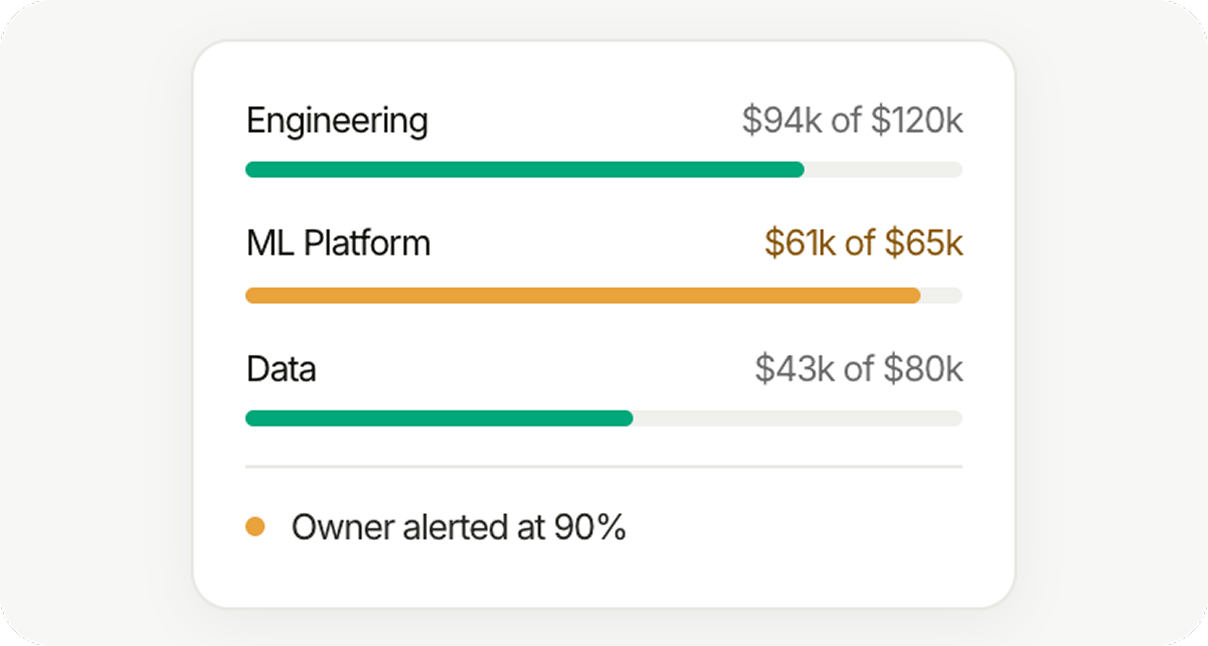
Budgets
Track actual and projected spend against configured budget thresholds, and alert owners when spend is approaching or expected to exceed them.
Bring query-level control to your BigQuery spend
Other integrations
.png)

.svg)
.png)
.png)
.png)
OneLens combines GCP billing data with BigQuery job, reservation and table metadata to cover on-demand analysis, Editions slot reservations and commitments, logical and physical storage, streaming inserts and scheduled queries. Teams can then act on query fixes, the right pricing model per workload, storage billing and unused tables rather than a single BigQuery line on the invoice.
OneLens prices every query from bytes billed or slot usage and flags full table scans, SELECT *, missing partition filters and repeated queries, with partitioning, clustering, materialized views or BI Engine as the fix. It also models on-demand against BigQuery Editions per project and workload, and finds idle or oversized slot reservations rather than applying one model everywhere.
Yes. OneLens compares logical and physical storage billing per dataset, including the time-travel and fail-safe bytes that physical billing charges for, so high-churn tables that would cost more stay where they are. It also shows whether a shorter time-travel window saves enough to be worth it, rather than recommending one switch for every dataset.
OneLens attributes each job through its project, service account, user, reservation and labels, then maps those to teams with business mappings and virtual tags. Shared slot reservations are split by each team's actual slot usage, so allocation does not depend on every query carrying a perfect label.
Cloud Billing reports show BigQuery spend by project, SKU and label, which works well for reconciling the invoice. OneLens adds the query, table, reservation and owner behind each cost, ranks the fixes by dollar impact and alerts the owner when spend moves, rather than stopping at the monthly total.
Many tools list expensive queries and leave the follow-up to your team. OneLens puts a dollar value on each fix across queries, slot reservations, storage billing and unused tables, then turns it into a ticket with an owner and the potential savings. The same cost model covers AWS, Azure, GCP and OCI, so BigQuery is never managed in isolation.
Yes. OneLens tracks BigQuery spend against budgets by team, project or reservation, projects month-end spend and alerts owners as it approaches the limit. The forecast shows which queries, pipelines or reservations are driving the overrun, rather than an unexplained projected number.
OneLens covers AWS, Azure, GCP and OCI alongside Kubernetes, GPU infrastructure, LLM and AI spend, and observability costs. Data platforms such as BigQuery, Snowflake and Databricks sit in the same cost model, so data, cloud and AI spend can be compared and governed in one place.




.jpeg)
